

TIFF to PDF
Convert TIFF to PDF free with a visual image workbench. Add TIFF or TIF scans, including multi-page files, arrange the source cards, choose page and quality settings, then create one PDF. Processing runs locally in your browser, and Frisqoo does not upload the source files. No sign-up or watermark; large scans depend on available device memory.
100% private. Your files are processed entirely in your browser and never uploaded.
HEIC and HEIF photos need Safari on iPhone or Mac. In other browsers, export them as JPG first.
Why convert TIFF to PDF with frisqoo
Local processing
TIFF decoding and PDF creation happen in your browser rather than through a file upload.
Multi-page input
Every readable internal TIFF page is added to the PDF in source order.
Page controls
Choose image-sized pages or standard paper with layout and margin options.
Two quality modes
Use PNG-based Best quality or JPEG-based Smaller file for decoded TIFF pages.
Undo and Redo
Reverse order, rotation, removal, and setting changes before export.
Free on your device
No sign-up or watermark. Available browser memory sets the practical job size.
How to convert TIFF to PDF
- Add TIFF or TIF files by dropping them in the box above or choosing them from your device.
- Drag source cards into order. Rotate or remove a source, or add more images to the current set.
- Choose Fit to image, A4, or Letter, then select Best quality or Smaller file.
- Click Create PDF. Open the result and check its internal page count, order, and rotation.
The original scans are not overwritten. Frisqoo creates a separate PDF on your device.

Multi page TIFF to PDF conversion
A TIFF can contain one image or a sequence of internal pages. The converter decodes each readable internal page and adds it to the PDF in the order stored in that TIFF. Several TIFF source cards are processed from left to right, and each file's internal pages stay together.
The workbench represents one TIFF file with one card. Its thumbnail is based on the first internal page. The remaining internal pages appear only in the exported PDF. Dragging the card moves the complete TIFF. Rotating it applies the same turn to all PDF pages created from that source. To rearrange or rotate internal pages separately, create the PDF first and continue with Organize PDF.
Arrange scans and preview page settings
Drag source cards into document order, rotate one source left or right, remove a mistake, or use Add images to extend the job. The toolbar can rotate every source together. Undo and Redo cover card order, rotation, removal, and page-setting changes.
The thumbnail uses the same size and placement calculations as export for the first page of each TIFF. It shows the selected page shape, margins, placement, and source rotation. Because later internal TIFF pages are not shown as separate cards, verify those pages after download.
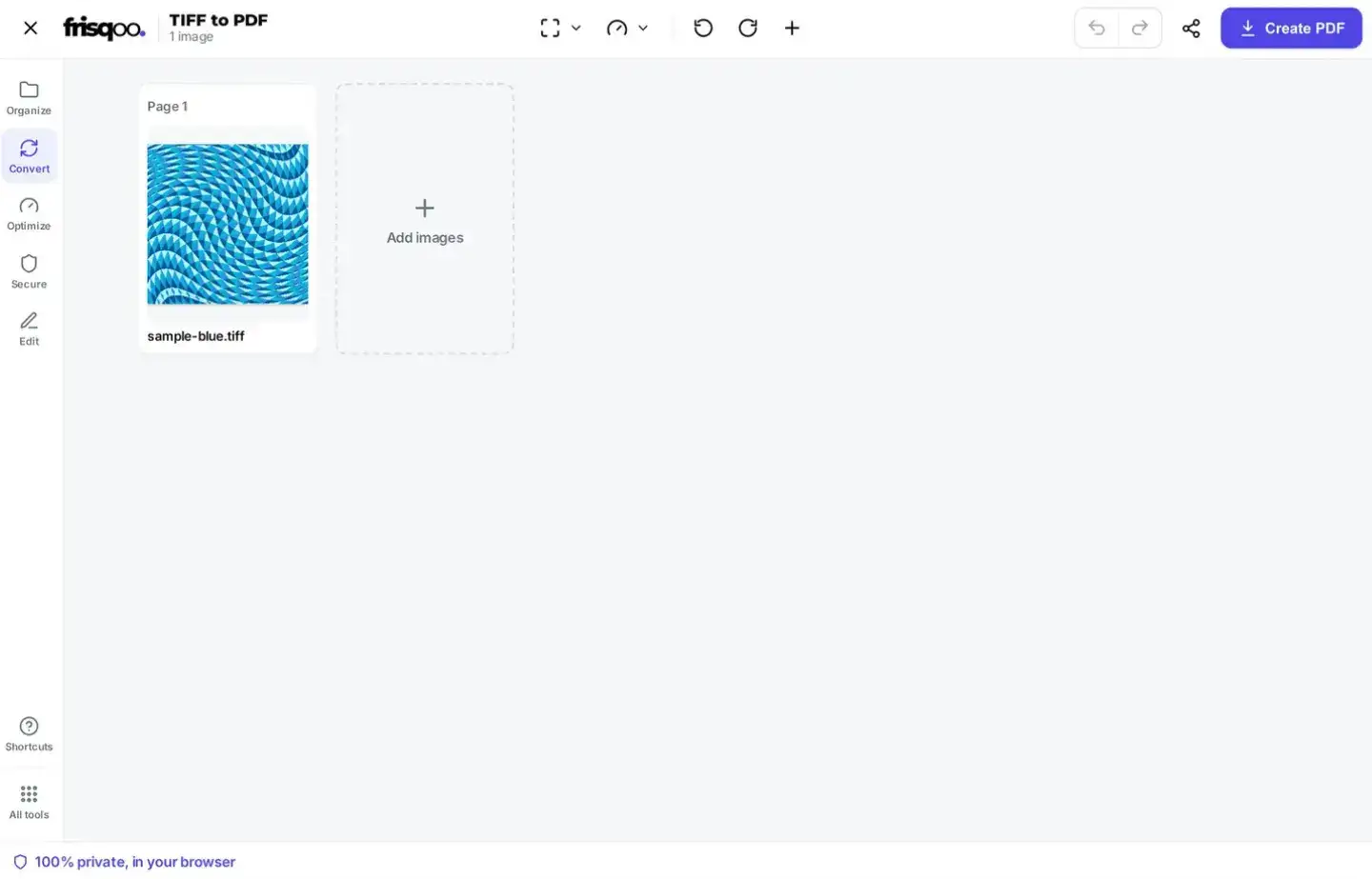
From scan to PDF pixels
TIFF is a container and may use different compression methods, color modes, resolutions, or transparency. This tool decodes each readable page to pixels before placing it in a new PDF. The resulting page is an image, not searchable text, editable document text, or a copy of the original TIFF container.
The conversion does not carry scanner tags, camera details, resolution tags, or other source metadata into the new document. Frisqoo writes its own PDF producer and creator values. When archival requirements depend on TIFF tags, color profiles, searchable OCR text, or a specific preservation standard, keep the original TIFF files with the PDF.
Choose a quality mode for TIFF scans
Best quality decodes each TIFF page and embeds PNG output. It avoids an added JPEG compression step and can keep transparent pixels. It does not preserve the original TIFF encoding or guarantee a smaller file. High-resolution scans can therefore make a large PDF.
Smaller file uses JPEG at the engine's current quality setting. JPEG is lossy and fills transparent areas with white. It can suit photo-heavy scans when file size matters more than retaining every decoded pixel. For small type, line drawings, maps, and signatures, inspect a zoomed section before deciding.
Page size, layout, and margins
Fit to image makes each PDF page follow the decoded scan dimensions and places the image edge to edge. A4 and Letter create standard paper pages. Those sizes unlock Auto, Portrait, or Landscape layout and None, Small, or Large margins.
Auto follows each decoded page's shape; a fixed orientation keeps standard sheets consistent. Images are scaled proportionally into the available area. Different internal TIFF pages may have different dimensions, so review the finished document before printing.
Combine TIF to PDF in source order
Add several .tif or .tiff files to build one document. Every readable internal page from the first card is written before the pages from the next card. Other supported image formats can be mixed into the same job.
One source card uses its base filename with a .pdf extension. Several source cards download as frisqoo_tiff-to-pages.pdf. The completed panel reports how many PDF pages were saved and identifies source files the browser could not decode.
Review the converted document
Open the downloaded PDF and compare the first and last pages with the source scans. Check the total page count, internal page order, card order, rotations, margins, and paper size. Zoom into small text and fine lines to judge the chosen quality mode.
If a multi-page TIFF needs page-level changes, use Organize PDF after conversion. Use Compress PDF when the completed document is larger than required, while keeping the first output as a reference.
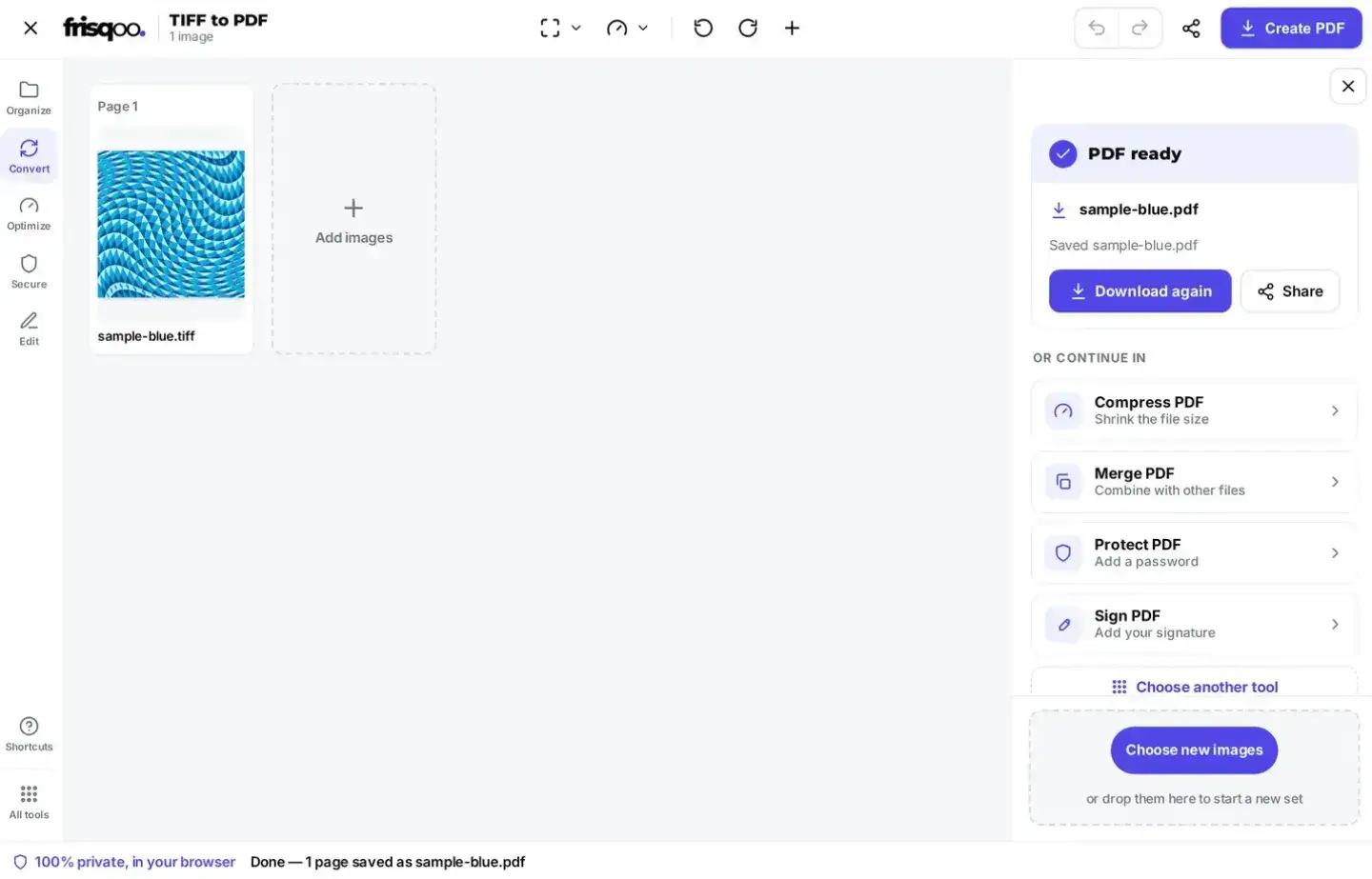
TIFF to PDF without uploading source scans
File reading, TIFF decoding, previews, ordering, rotation, and PDF creation run locally in the browser. Frisqoo does not upload the source files for this operation. Keep the page open until creation and download finish.
Large, high-resolution, or multi-page TIFFs can use substantial memory because pages are decoded before PDF embedding. Process fewer source files at a time if a phone or older computer runs short of memory, then combine the smaller PDFs with Merge PDF.
TIFF to PDF on phone and tablet browsers
Current mobile browsers can add stored scans, reorder source cards, rotate them, change page settings, and create the PDF. Card actions remain visible on touch layouts, and the grid narrows for smaller screens.
Device file pickers and TIFF support can vary. The built-in TIFF decoder handles readable TIFF data after the file is selected, but available browser memory remains the main limit for long or high-resolution scans.
Formats you can add
- TIFF and TIF, including readable multi-page files
- JPG, JPEG, PNG, and WebP
- AVIF, BMP, and GIF
- SVG graphics, rasterized through the browser for PDF embedding
- HEIC and HEIF when the browser and device can decode them
For a format-neutral entry point, JPG to PDF uses the same mixed-image workbench.
FAQs about TIFF to PDF
Do my TIFF files get uploaded?
No. Processing runs locally in your browser. Frisqoo does not upload the source files for this task. Keep the tab open until the PDF finishes downloading.
How does this TIFF to PDF converter handle multi-page files?
Each readable page inside a multi-page TIFF becomes a separate PDF page in its original internal order. The editor shows one source card using the TIFF's first page as its preview, so check the completed PDF's page count.
Can I convert TIF to PDF too?
Yes. .tif and .tiff are filename extensions for the same format family, and both follow the same conversion path here.
What is the difference between the quality modes?
Best quality decodes TIFF pages and embeds PNG output. Smaller file converts them through JPEG at the engine's current quality setting. JPEG is lossy and fills transparent areas with white.
Can I preview every page of a multi-page TIFF?
Not before export. One TIFF is represented by one card, and its thumbnail comes from the first internal page. Export reads every internal page, so open the finished PDF and verify the page count and order.
Can I reorder pages inside one TIFF?
Not individually in this workbench. Dragging a card moves the whole source file, with its internal pages kept together. Convert first, then use Organize PDF when individual PDF pages need a different order.
Can I rotate pages in a multi-page TIFF?
A card's Rotate left or Rotate right action applies the same quarter-turn to every exported page from that source TIFF. Use Organize PDF afterward when different pages need different rotations.
Can I combine several TIFF files?
Yes. Drag the source cards into order. Every readable page from the first TIFF is added before every readable page from the next source card.
Can I mix other image formats with TIFF?
Yes. The workbench accepts JPG, PNG, WebP, AVIF, BMP, GIF, SVG, HEIC, and HEIF. HEIC and HEIF depend on browser and device decoding support.
What filename will the PDF use?
With one source file, the PDF uses that file's base name. With several source cards, TIFF to PDF downloads frisqoo_tiff-to-pages.pdf. The ready panel also offers Download again and sharing when supported.
Can I use TIFF to PDF on a phone?
Yes. Current mobile browsers can add files, reorder cards, rotate sources, change page settings, and download the result. High-resolution or multi-page scans can need substantial device memory.
Can I use TIFF to PDF offline?
Once the page and required code have loaded, conversion runs locally. Keep the tab open while working; reloading the site may require a connection again.
Is TIFF to PDF free?
Yes. There is no sign-up or watermark. Frisqoo does not impose a fixed file-count cap here, but the practical limit is the memory available to your browser.