

Extract Images
Extract images from a PDF without turning every page into a screenshot. Add one file to inspect and select its stored pictures, or add several PDFs to pull out every readable image in sequence. JPEG and JPEG 2000 streams can keep their original encoded bytes; other supported streams are decoded to PNG. Processing runs in your browser, and Frisqoo does not upload the source PDF for this task. This lets you extract images from PDF locally after the page code has loaded.
100% private. Your files are processed entirely in your browser and never uploaded.
Why use this PDF image extractor?
Local processing
The source PDF is read in your browser instead of being uploaded for extraction.
Stored images, not pages
Pull out embedded raster pictures without rendering every PDF page as one image.
Selection for one PDF
Use thumbnails, page references, dimensions and checkboxes to choose the files you need.
Sequential batch mode
Two or more PDFs are processed one after another, with a separate result for each source.
Direct files or ZIPs
Save one image directly, package multiple images, or collect completed batch rows as a ZIP.
Responsive editor
The tool works on desktop and mobile, subject to browser memory and screen space.
How to extract images from a PDF
- Select Choose PDF files and add one document for a reviewable checklist, or add two or more for automatic batch extraction.
- In single-file mode, inspect each thumbnail and its pixel size, page reference and format label. Clear unwanted rows or use the 64px filter for small assets.
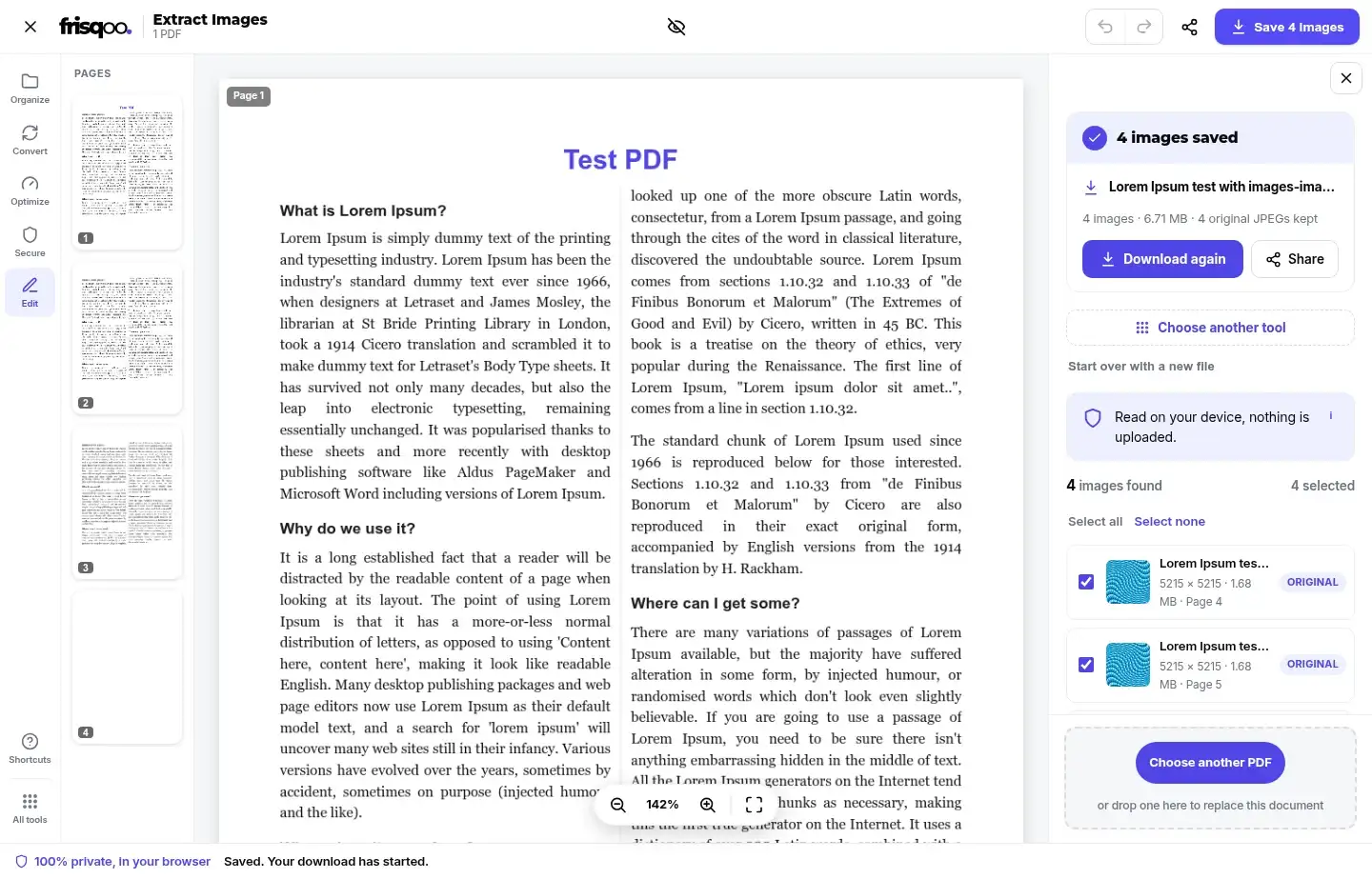
- Select Save image or Save images. One selection downloads directly; multiple selections are packed as
name-images-extracted.zip.
This tool extracts raster image objects stored inside a PDF. It does not perform OCR, rebuild vector graphics, or create an image of each complete page.
Start with one PDF or several
The same drop area supports two workflows. One PDF opens the editor shell so you can decide which pictures to keep. Two or more PDFs stay on the page and start batch mode, where every readable image is extracted from each document. Use the single-file path when selection matters and the batch path when the goal is to extract all images from PDF files with the same routine.
A known-password document can be unlocked from the drop area before processing. The unlock step permits the tool to read that source; it does not transfer password protection to the resulting JPG, JP2, PNG or ZIP files.
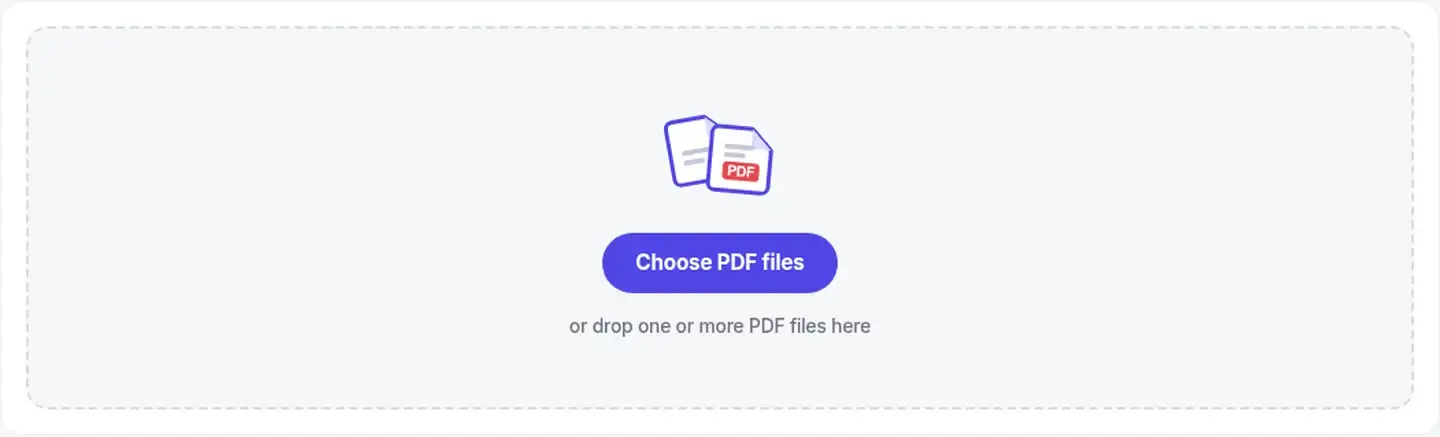
Choose images in the single-file editor
After discovery and decoding, the side panel lists each available image with a thumbnail, filename, stored width and height, output size and page location. Select all, select none, or change individual checkboxes. The primary button follows the current selection and switches between saving one image and saving several images.
The toolbar filter hides a result when either dimension is shorter than 64 pixels. It is useful for tiny bullets, rules and decorative assets, but it can also hide a legitimate small icon. The filter starts switched off. Images with either stored dimension below 16 pixels are excluded during discovery and cannot be restored with the filter.
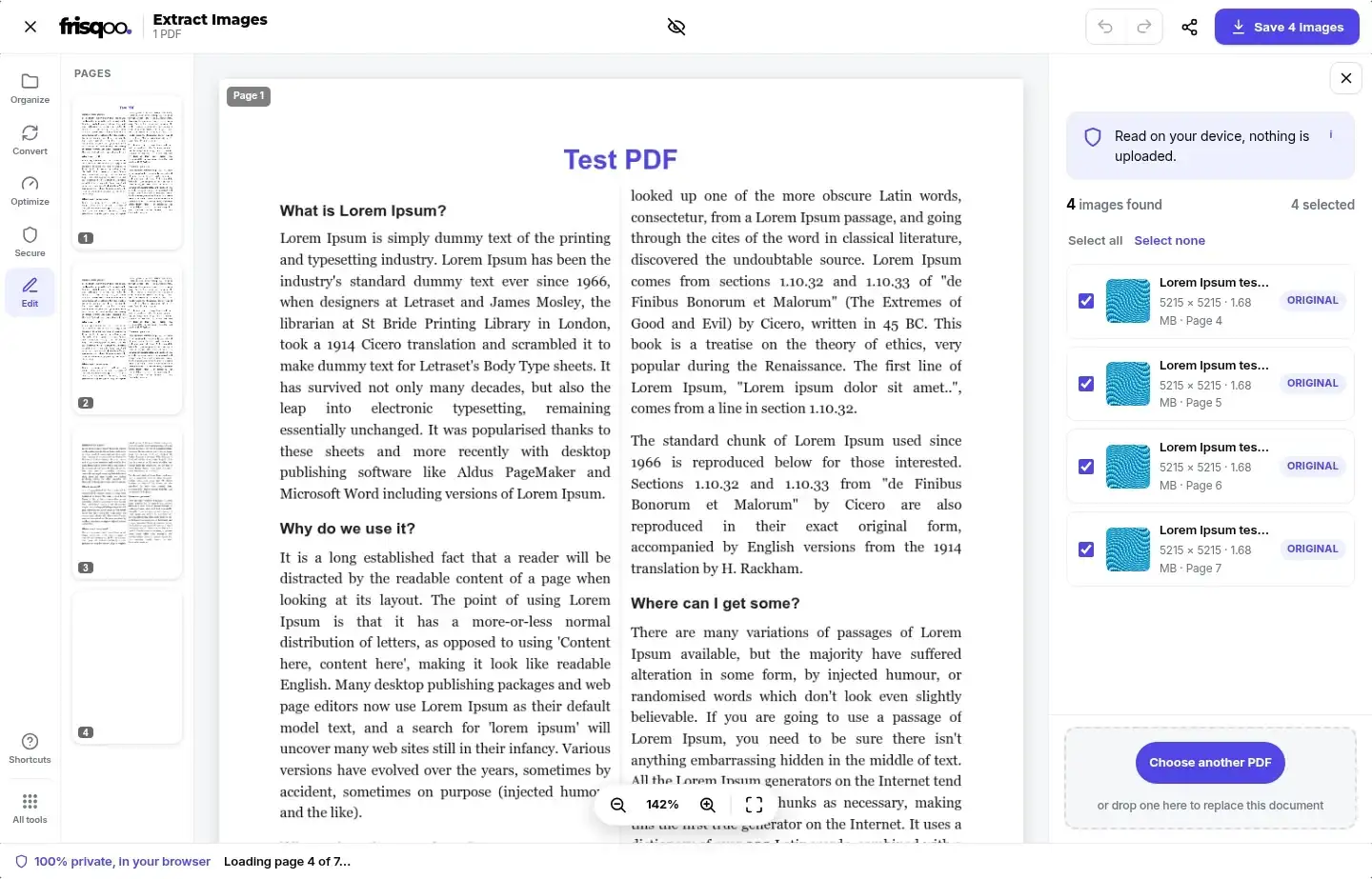
Understand JPG, JP2 and PNG output
PDF images are encoded streams rather than a ready-made folder of files. When the final stream filter is DCT, the tool saves its stored bytes as .jpg. A JPX stream is passed through as .jp2. These results receive an ORIGINAL label because the encoded stream is not recompressed.
Other supported streams are decoded into pixels and written as PNG at the stored pixel dimensions. You can therefore extract images from PDF as PNG when the source stream and colour space are supported. The decoder covers common grayscale, RGB, CMYK, indexed and mask cases, including packed 1-bit, 2-bit and 4-bit samples. It does not safely interpret every colour space or compression method found in the PDF specification. An unsupported or damaged stream is skipped instead of being exported as a misleading file.
PNG output can receive alpha from a readable soft mask. JPEG, JPEG 2000, JBIG2 and CCITT-compressed soft masks are not decoded by this path, so the saved image can be opaque. Check colour, transparency, orientation and visible edges before using an extracted image in production.
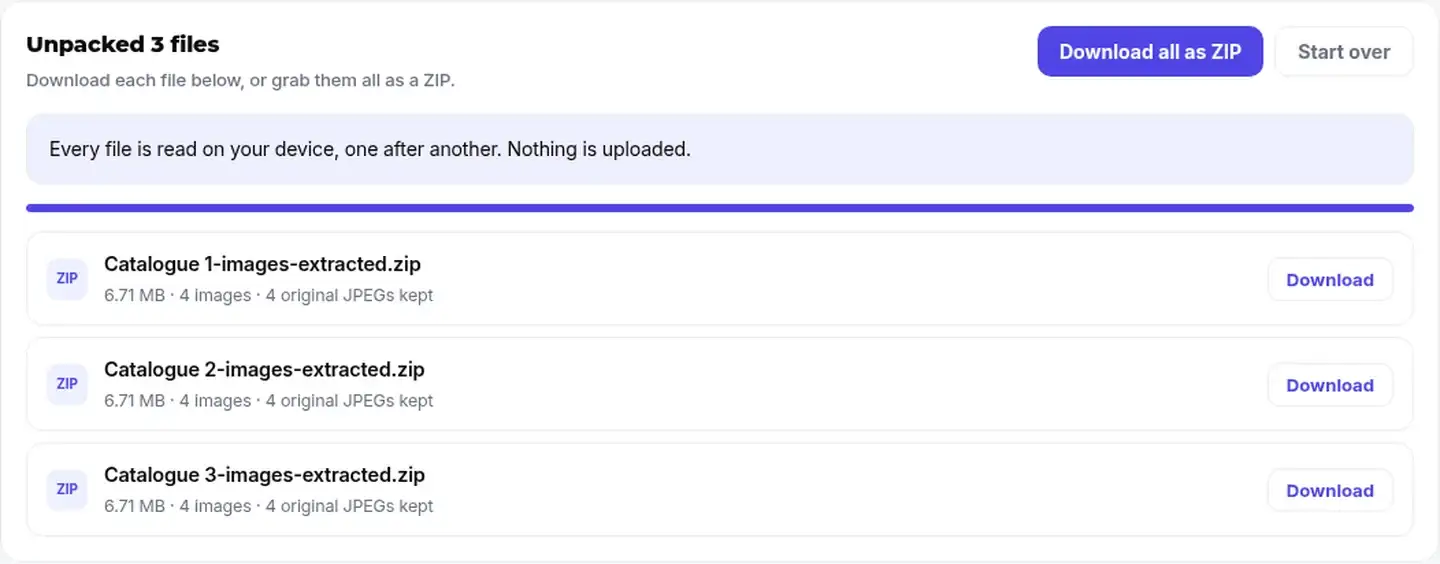
Extract images from multiple PDFs in batch
Batch mode deliberately has no image checklist. Each source is read in order and every image that can be extracted is included. A PDF with one usable image returns that image directly. A PDF with several usable images returns source-images-extracted.zip. A file with no image objects, or with no streams the decoder can read, produces a failed row rather than an empty archive.
Download all as ZIP creates frisqoo_images-extracted.zip. When source PDFs produced their own archives, those ZIP files sit inside the outer batch ZIP. This extra level keeps images grouped by source PDF and avoids collisions between similar page-based filenames.
Documents are processed sequentially, which limits simultaneous work, but completed blobs, thumbnails and archives still occupy memory. For photo catalogues or long scans, use smaller batches and keep enough free storage for the generated downloads.
What this tool does not extract
A PDF page can contain text, paths, gradients, vector logos, form appearances and raster images. This extractor follows page resource dictionaries and nested form resources to find raster image objects. It can extract embedded images from PDF resources even when they sit inside a nested form. It does not rasterize the whole page, run OCR, recover editable chart data, or convert vector artwork into SVG. A chart that looks like a picture may therefore produce no image result if it is built from drawing commands.
Repeated use of the same stored image is deduplicated. The editor lists that object once and records every page on which it was found, rather than giving you identical copies. If the goal is a faithful picture of each complete page, including text and vectors, use PDF to JPG instead. If the goal is text from a scan, use an OCR workflow rather than this image extractor.
File names and page references
Every result begins with the source PDF base name. A unique image found on page 3 can be named catalogue-page3-1.jpg. If the same stored object appears on pages 3, 4 and 5, the page portion becomes pages3-4-5. More than three appearances use the first page and a shorter count such as page4-and9more. The final number distinguishes separate image objects that would otherwise receive the same name.
The page labels describe where an object was referenced, not reading order or the visual position on the page. Keep the original PDF until you have checked the extracted set. It remains the best reference when several similar photos, logos or scans need to be matched back to their context.
Password prompts and an output review checklist
When a PDF requires an open password, enter the known password in the prompt. The tool uses it on your device and then continues into the editor or batch queue. If a password is unknown, skip that document or obtain an authorized copy; this workflow does not bypass encryption.


Before closing the source, review the downloads:
- Open every JPG, JP2 and PNG that matters and confirm it renders in the destination app.
- Compare colour, transparency, orientation and edge quality with the PDF preview.
- Check the page label when several similar images were stored in the document.
- Confirm that an expected logo or chart was a raster image rather than vector artwork.
- Keep the original PDF when provenance, rights, signatures or document context matter.
Using the extractor on phones and large documents
On a narrow screen, the editor still provides the PDF preview and image controls, but the available panel space is smaller and long lists require more scrolling. Saving several images also asks the browser to build a ZIP locally. A desktop device is usually more comfortable for comparing thumbnails or handling many high-resolution photos.
There is no server queue or upload-size rule in this extraction path, but that does not make device resources unlimited. Practical capacity depends on the source structure, image dimensions, number of decoded PNGs, browser memory and free storage. If a large job stalls, reload the page, reduce the number of source files, save fewer images at once, and verify each smaller result before continuing.
FAQs about Extract Images
Does Frisqoo upload my PDF?
The extraction runs in your browser, and Frisqoo does not upload the source PDF for processing. The page and its code must load before the tool can run.
Which image formats can it extract?
JPEG streams are saved as .jpg and JPEG 2000 streams as .jp2 without re-encoding. Other supported image streams are decoded to .png. An uncommon colour space, compression method or damaged stream may be skipped rather than written incorrectly.
Does extracting images reduce their quality?
JPEG and JPEG 2000 streams that the tool can pass through keep their stored bytes. Images converted to PNG keep the stored pixel dimensions, but decoding can change the representation and some PDF colour spaces are unsupported. Review important output before reuse.
Can I extract all images from several PDFs?
Yes. Add at least two PDFs to start batch mode. Every readable image is taken from each file in sequence; there is no per-image checklist in batch mode.
Why did the tool find no images?
The page may be made from text, vectors and drawing commands instead of embedded image objects. The tool also ignores an image if either stored dimension is below 16 pixels, and it skips streams it cannot decode safely.
Can it extract vector graphics or a whole PDF page?
No. It extracts stored raster image objects, including images inside nested form resources. It does not render text, vector artwork or a complete page. Use PDF to JPG when you need page images.
What does Hide images under 64px do?
It removes a row from the visible checklist when either dimension is below 64 pixels. This can hide bullets, rules and small interface assets. The filter starts off and does not delete anything from the PDF.
What happens when the same image appears on several pages?
A reused image object is listed once, with the pages where it was found. Its filename includes up to three page numbers; longer page lists use the first page followed by an “and more” count.
Does it preserve transparency?
For PNG output, the tool applies a readable soft mask as alpha. A soft mask compressed as JPEG, JPEG 2000, JBIG2 or CCITT is not decoded, so that result can be opaque. Image stencils are written as transparent PNGs when supported.
Can I use a password-protected PDF?
A PDF that requires an open password can be unlocked in the drop area when you know the password. The password is handled on your device. Extracted images are ordinary image files and are not password-protected.
Will it work with a very large PDF on a phone?
It can run in a current mobile browser, but extraction, thumbnails and ZIP creation use device memory. Large scans and photo-heavy documents are better handled in smaller batches on a device with more free memory.