

PNG to PDF
Convert PNG to PDF free with a visual image workbench. Add one PNG or a batch, drag images into order, rotate or remove them, choose the page size and quality mode, then tap Create PDF. Processing runs locally in your browser, and Frisqoo does not upload the source files. No sign-up or watermark; large batches depend on available device memory.
100% private. Your files are processed entirely in your browser and never uploaded.
HEIC and HEIF photos need Safari on iPhone or Mac. In other browsers, export them as JPG first.
Why convert PNG to PDF with frisqoo
Local processing
The source images are opened and combined in your browser rather than uploaded for processing.
Page previews
See the page size, orientation, margins, image placement, order, and rotation before creating the PDF.
Arrange every image
Drag thumbnails into order, rotate individual images, remove mistakes, or add more files.
Flexible pages
Use image-sized pages or choose A4 or Letter with layout and margin controls.
Undo and Redo
Step through order, rotation, removal, and setting changes before building the file.
Free on your device
No sign-up or watermark. Large image sets depend on available browser memory.
How to convert PNG to PDF
- Add one or more PNG files by dropping them in the box above or choosing them from your device.
- Drag thumbnails into page order. Use each card's controls to rotate or remove an image, and use Add images when another file is needed.
- Choose Fit to image, A4, or Letter. Standard pages also expose layout and margin options. Select the quality mode that fits the mixed formats in the job.
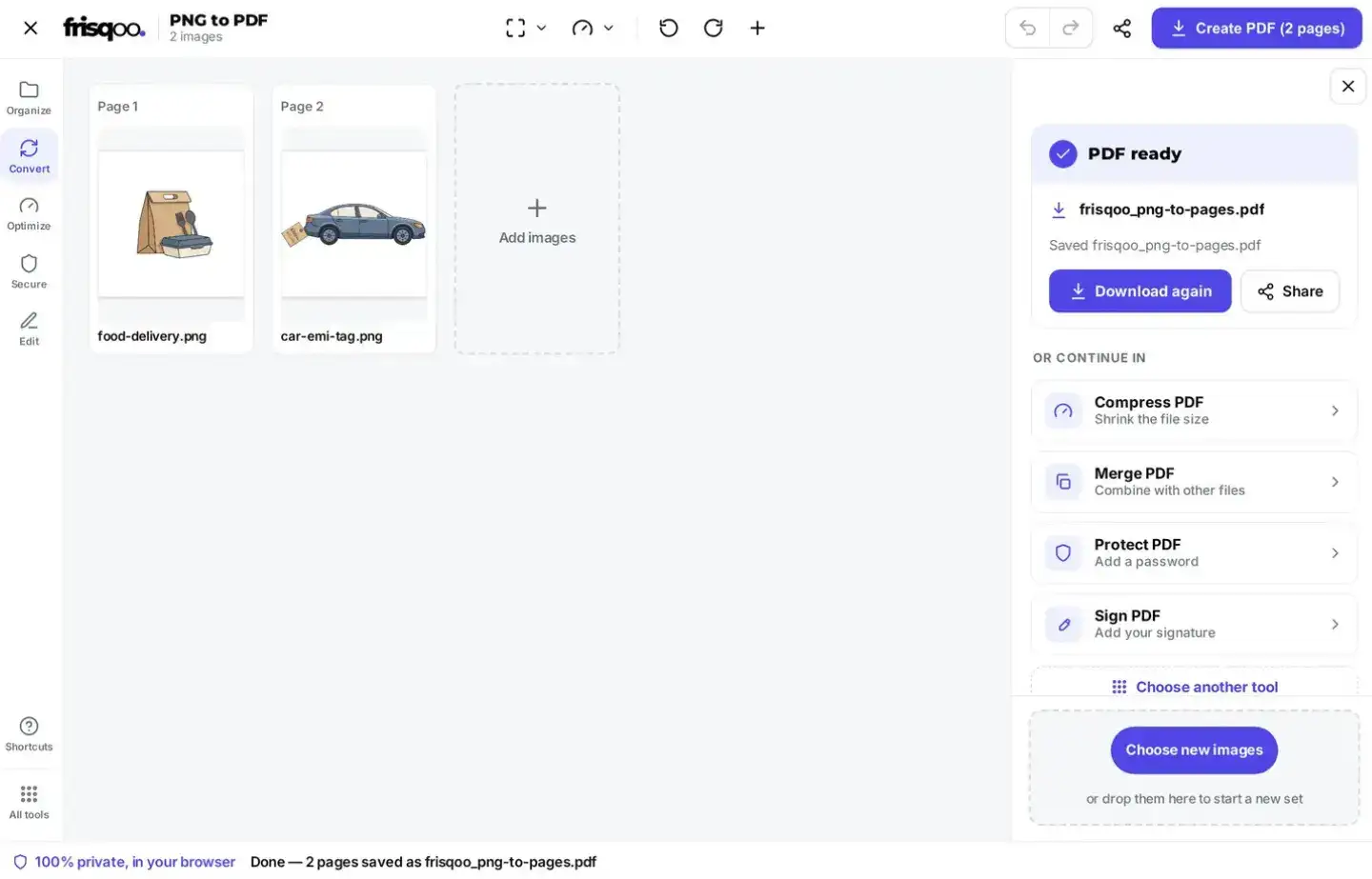
- Click Create PDF. Review the saved filename and page count in the completed panel, then use Download again if needed.
The original images are not overwritten. Frisqoo creates a separate PDF on your device.

Arrange images and preview the PDF pages
Every source image appears as a numbered card in the workbench. Drag the cards into the reading order you want; the PDF follows that order from Page 1 onward. Each card also has controls to rotate left, rotate right, or remove the image. Toolbar actions rotate all images together, while Add images extends the current document without starting over.
The preview uses the same page dimensions and placement math as the exported PDF. It shows whether an image is portrait or landscape, how much white page area surrounds it, and how a manual or JPEG EXIF rotation affects its position. Undo and Redo cover ordering, rotation, deletion, and setting changes.
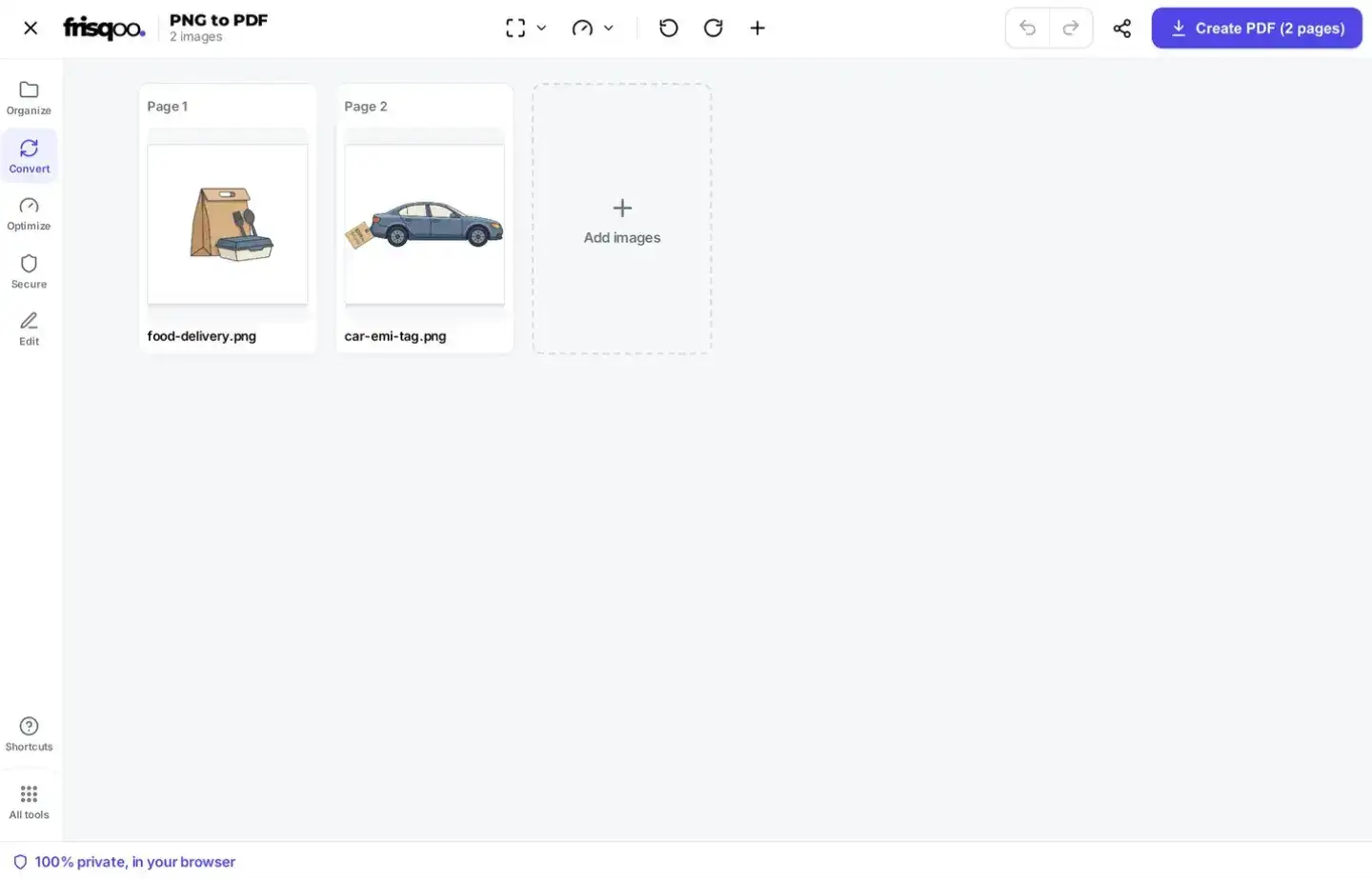
Image to PDF page size, layout, and margins
Fit to image makes each PDF page follow the image dimensions and places the picture edge to edge. This works well for screen viewing or when images use different aspect ratios. A4 and Letter create standard paper pages instead.
After choosing A4 or Letter, set Layout to Auto, Portrait, or Landscape. Auto follows the image shape on each page; the fixed choices keep every page in the selected orientation. Margins can be None, Small, or Large. The workbench scales each image proportionally to fit the available area without deliberately stretching it.
Transparent PNG to PDF backgrounds
A transparent PNG can be embedded with its alpha information. Transparent areas reveal the PDF page beneath the image, and PDF readers normally display that page background as white. The converter does not offer a background-color picker, so add the required color to the source image first when white is not the intended appearance.
Transparency also affects file design. A logo or icon may look correct on a white page but different in a reader that uses unusual display effects. Open the downloaded PDF and inspect representative transparent graphics before sharing or printing it.
PNG quality and mixed image formats
PNG inputs use the engine's direct PNG embedding path. They are not sent through the canvas-based conversion used for formats that need browser decoding. The Best quality and Smaller file setting can change how compatible converted formats are encoded, but it does not turn a directly embedded PNG or JPG into a different format.
This distinction matters in mixed jobs. WebP, AVIF, BMP, GIF, SVG, and other browser-decoded images may be drawn through a canvas before embedding. Smaller file uses JPEG encoding for those compatible conversions, which fills transparent pixels with white. Best quality uses PNG encoding where conversion is required. Very large source dimensions still increase browser-memory use and PDF size.
Combine PNG to PDF in a fixed order
Add several PNG files to build one document rather than a folder of separate images. Each PNG creates one page, and the numbered thumbnail order becomes the PDF page order. A multi-page TIFF mixed into the same job is different: every readable TIFF frame becomes a page even though the workbench displays one card for that source file.
With one source image, the output uses the source base name and a .pdf extension. With several source-image cards, the output is frisqoo_png-to-pages.pdf. The completed panel reports how many pages were saved and notes unreadable images that were skipped.
After downloading, open the PDF and inspect the first and last pages, the order around any rotated image, and the page count shown by the reader. For a print job, check the chosen paper size, orientation, margins, and transparent areas before deleting the original images or sending the file. Zoom into one text-heavy screenshot or diagram as a quick check that its details remain readable.
Turn a screenshot to PDF without blurring text
PNG is commonly used for screenshots, interface captures, diagrams, charts, and line art because it preserves hard edges and small text. Direct PNG embedding keeps the source image available to the PDF without deliberate JPEG conversion. The PDF still displays an image rather than searchable document text, so words inside a screenshot do not become a selectable text layer.
For a walkthrough or bug report, order the captures from first step to last, use a consistent page size, and check that portrait and landscape screenshots use the intended layout. If the completed document is larger than needed, Compress PDF can be used as a separate follow-up step.
PNG to PDF without uploading source images
Image decoding, page previews, ordering, rotation, and PDF creation run locally in the browser. Frisqoo does not upload the source files for this operation. Source camera, location, and other image metadata is not promoted into the new PDF's document metadata; the PDF receives Frisqoo producer and creator values.
Local conversion still depends on browser support. HEIC and HEIF often open in Safari on supported iPhone and Mac devices, while many Chrome, Firefox, and Edge setups cannot decode them. If a HEIC file cannot be read, save or share it as JPG and add that version. Unreadable files are reported rather than silently becoming blank pages.
PNG to PDF on phone or tablet browsers
Current mobile browsers can run the same workflow. Choose images from device storage, drag cards into order, rotate them, and set the page options before creating the PDF. On touch screens, the image-card actions remain visible, and page cards use a narrower grid.
High-resolution screenshots and long batches can use substantial memory. Keep the tab open until the download finishes, close other memory-heavy tabs when necessary, and review the result in a PDF reader before deleting the source images.
Formats you can add
PNG is the focus, but the shared image workbench accepts other supported image files in the same document:
- PNG and JPG or JPEG
- WebP, AVIF, BMP, and GIF
- TIFF, including readable multi-page TIFF files
- SVG vector graphics, rasterized through the browser for PDF embedding
- HEIC and HEIF when the browser and device can decode them
GIF input is treated as an image source rather than an animation sequence. For a format-neutral starting point, JPG to PDF uses the same workbench and accepts the same mixed-image set.
Common ways to use PNG to PDF
- Bundling screenshots into a walkthrough, handover, or bug report.
- Turning UI mockups and design exports into one ordered review document.
- Combining charts, diagrams, or scanned line art onto printable pages.
- Placing transparent logos and graphics on standard white PDF pages.
- Creating one file from mixed PNG, JPG, WebP, SVG, or TIFF sources.
FAQs about PNG to PDF
Do my PNG images get uploaded?
No. Processing runs locally in your browser. Frisqoo does not upload the source images for this task. Keep the tab open until the PDF finishes downloading.
What happens to transparent PNGs?
PNG transparency is supported by the embedded image. Transparent areas reveal the PDF page background, which PDF readers normally display as white. The tool does not let you choose a custom background color.
Can I preview the page size, layout, and margins?
Yes. The thumbnails use the same page-size and placement calculations as the exported PDF. Fit to image follows each picture's dimensions. A4 and Letter add Auto, Portrait, or Landscape layout and None, Small, or Large margins.
Will my PNG images be recompressed?
PNG inputs are embedded directly rather than passed through the canvas conversion used for other formats. The Best quality and Smaller file setting can affect compatible non-PNG images mixed into the document, but it does not convert a direct PNG input to JPEG.
Can I combine PNG to PDF in a chosen order?
Yes. Add several images and drag their thumbnails into the required order. Each PNG becomes one PDF page, and the Create PDF button shows the current page count.
Can I rotate or remove an image?
Yes. Each thumbnail has Rotate left, Rotate right, and Remove image controls. The toolbar can rotate every image together, and Undo or Redo can restore earlier order, rotation, deletion, and settings states.
Can I add other image formats?
Yes. The workbench accepts JPG, WebP, AVIF, BMP, GIF, TIFF, SVG, HEIC, and HEIF as well as PNG. Browser decoding support varies for HEIC and HEIF; Safari on supported Apple devices can open formats that many other browsers cannot.
Does every source file make one PDF page?
Each PNG and most other image files create one page. A multi-page TIFF is the exception: every readable TIFF frame becomes its own PDF page even though the editor shows one source-file card.
What filename will the PDF use?
With one image, the PDF uses that image's base filename. With several source images, PNG to PDF downloads frisqoo_png-to-pages.pdf. The ready panel also provides Download again and the normal sharing action when supported.
Is source image metadata copied into the PDF?
The tool builds a new PDF from image pixels and writes its own PDF producer and creator values. Do not rely on source image metadata such as camera or location details being carried into the PDF.
Can I use PNG to PDF on phone browsers?
Yes. Current mobile browsers can add files, reorder thumbnails, rotate images, change page settings, and download the result. Large high-resolution batches need more device memory.
Can I use PNG to PDF offline?
Once the page and required code have loaded, conversion runs locally. Keep the tab open while working; reloading the site may require a connection again.
Is PNG to PDF free?
Yes. There is no sign-up or watermark. Frisqoo does not impose a fixed image-count cap here, but the practical limit is the memory available in your browser.