

Compress PDF
Compress PDF free, no sign-up or watermark. Add one PDF or a batch, compare measured results, and download a smaller copy when the browser finds one. Frisqoo processes the source file locally instead of uploading it for compression.
100% private. Your files are processed entirely in your browser and never uploaded.
Why compress PDFs with Frisqoo
Local processing
The source PDF and any open password stay in your browser while the tool works.
Measured choices
Compare genuine output sizes for Highest quality, Standard and Smallest file.
Text-aware handling
Real text stays text unless you deliberately choose to turn pages into pictures.
Batch compression
Compress several PDFs sequentially and collect finished files in one ZIP.
Scan reduction
Image-based pages can be re-encoded at 144, 108 or 72 dpi.
Browser based
Use the same controls on desktop or mobile, within the memory available to that device.
How to reduce PDF file size
- Choose one PDF, or add several files for a batch run.
- Start with Standard, then compare Highest quality or Smallest file if the measured result does not suit the job.
- Select Compress PDF, compare the sizes, download the result, and open it to review the pages and interactive features.
The browser performs the conversion locally. Keep this tab open until compression and the download are complete.

How Compress PDF chooses a method
Compress PDF first builds a structural candidate. It repacks streams and objects without photographing the pages again. This path is intended to keep real text, embedded fonts, links and form structures available while reducing avoidable overhead.
Scanned PDFs need different handling because their pages are already pictures. The tool can render those pages and encode them as JPEG images at the selected resolution. A white page background is applied during that process, so transparency in a scanned page should be checked in the result.
The browser compares valid candidates and keeps the smallest one only when it is smaller than the source. If a picture-based candidate would be larger, the structural copy wins. If neither saves space, the tool does not substitute a larger compressed file.
This explains why two files with the same page count can behave differently. A photo-heavy scan may shrink substantially, while an efficiently produced text report may change very little.
The comparison is performed directly on the PDF being processed. That makes the displayed sizes useful for choosing a level, but they apply only to that file and those settings. A second PDF with similar dimensions can contain very different image data, font subsets and object streams.
Choose a compression level
The three levels control pages that are encoded as pictures. They do not promise a particular file size or visual result, so use the measured values and inspect the downloaded PDF.
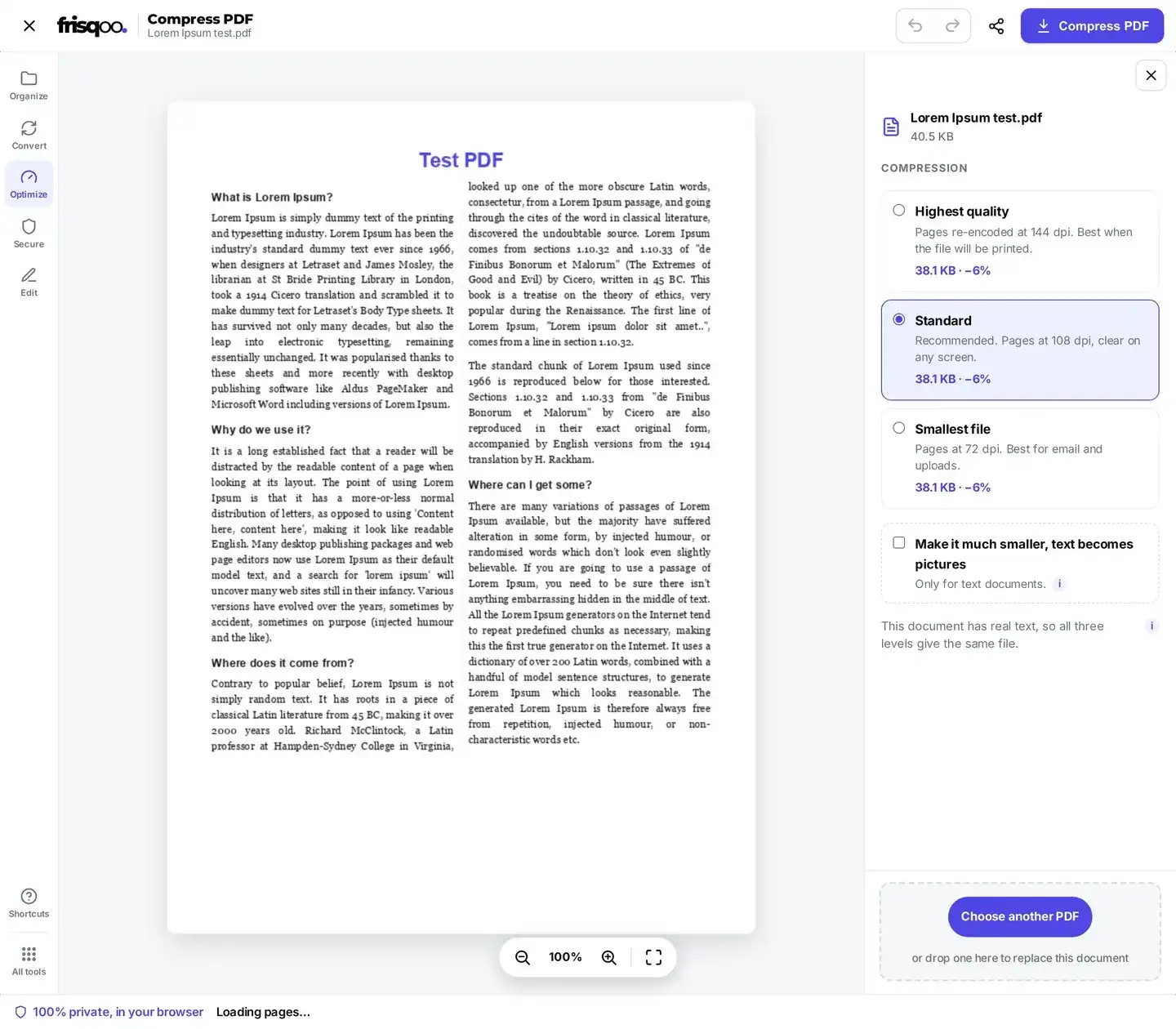
- Highest quality uses 144 dpi for rasterized pages and is the first choice to test when print clarity matters.
- Standard uses 108 dpi and is selected by default as a balanced screen-oriented setting.
- Smallest file uses 72 dpi and trades more image detail for a lighter result suited to strict email or upload limits.
For smaller jobs, the browser can calculate all three choices. For a PDF over 40 pages or 15 MB, it initially measures the selected level to avoid unnecessary work; use Work out other sizes when you want the remaining comparisons.
Changing the level updates the candidate used by the main action. The result is cached after measurement, so choosing Compress PDF can reuse the bytes that produced the displayed size instead of silently creating a different estimate.
Keep text or turn pages into pictures
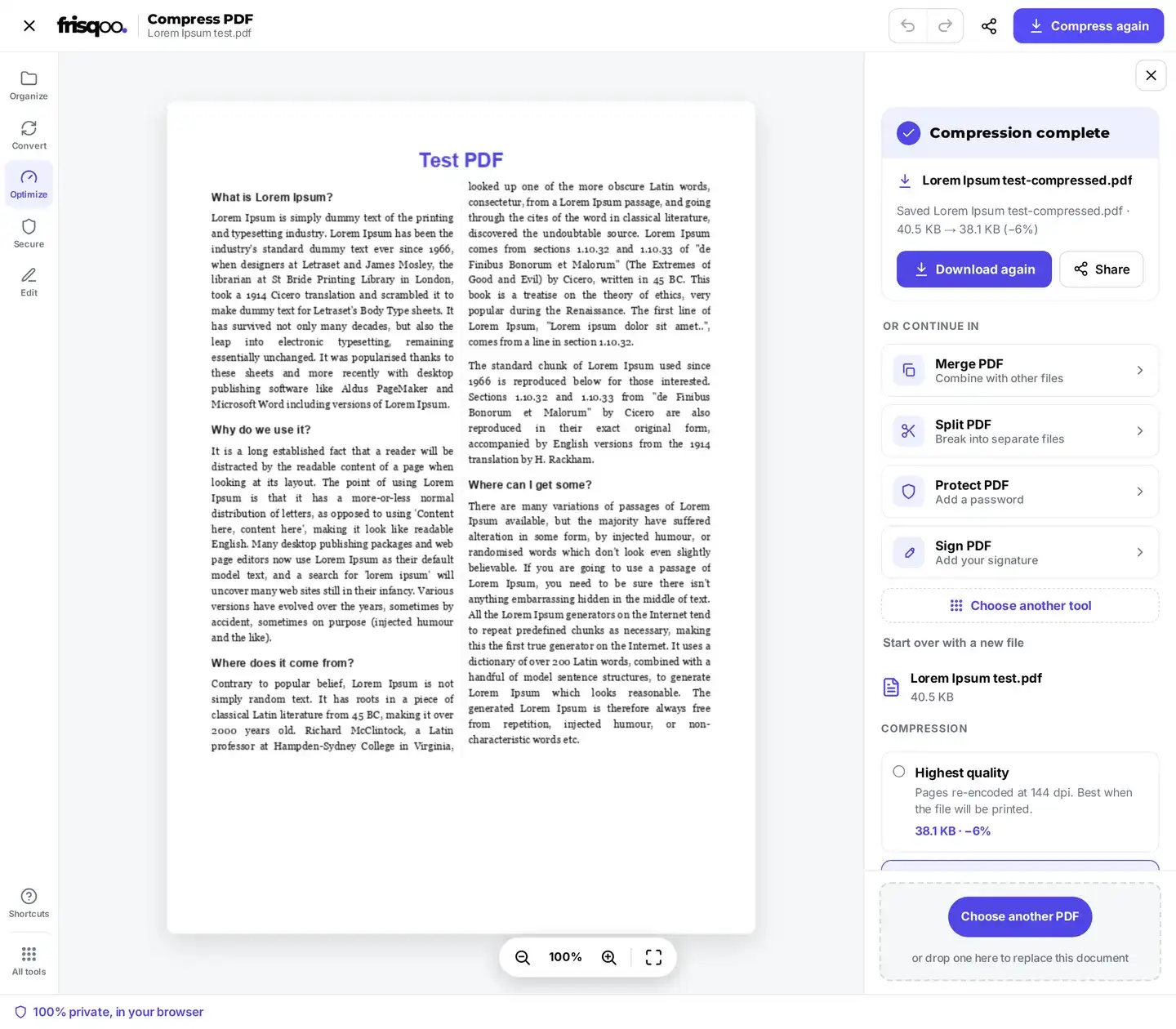
To reduce PDF file size without losing quality from re-rendering, leave Make it much smaller, text becomes pictures unchecked. The structural candidate keeps selectable and searchable text when that content exists in the source.
Enable the option only when a smaller number matters more than document structure. Every page is rebuilt as an image at the chosen dpi. Text can no longer be selected, searched or read as text, and links, form controls, bookmarks and other interactive structures are not retained in the raster copy.
The option is withheld for a dynamic XFA form because flattening that document can remove the behavior required to render or complete it. Even for ordinary PDFs, open the result and zoom into small text before using the picture path.
OCR and compression solve different problems. If a scan needs searchable text, use OCR PDF and confirm the recognition before deciding whether another compression pass is appropriate. Turning pages into pictures after OCR removes the searchable layer from the chosen result.
What the structural path keeps
The structural route is designed to keep pages in order and preserve text, fonts, links and AcroForm fields, including forms that carry XFA data. Preservation still needs a practical check because PDF producers use many variations of the format.
Compression rewrites file bytes. Verify bookmarks, document metadata, attachments and any digital signature in a PDF reader after download. If signature validity matters, keep the signed original and compress the document before signing rather than afterward.
Compress PDF does not convert a document to PDF/A. Use the format required by the receiving archive, court or portal, and retain the original when compliance or evidentiary value matters.
Annotations and layers also deserve a quick review. They can depend on structures outside the visible page content, especially in files exported by specialist design, engineering or records software. The preview shows a page image and cannot validate every PDF feature.
Compress password-protected PDF files
You can compress password-protected PDF files when you know the password required to open them. Enter it in the unlock prompt; the browser creates a working copy locally and continues to the compression controls. A restrictions-only file may open without a prompt.


The downloaded compressed PDF is not automatically protected again. If the new copy needs access control, open it in Protect PDF and apply a new password after reviewing the result.
Keep the protected source until the replacement has been checked. Unlocking is for a password you already know; the tool does not recover, bypass or remove an unknown open password.
Compress several PDFs at once
Add two or more files to run batch compression. One level and one Text may become pictures setting apply to the group, while each PDF is processed in sequence to control memory use.
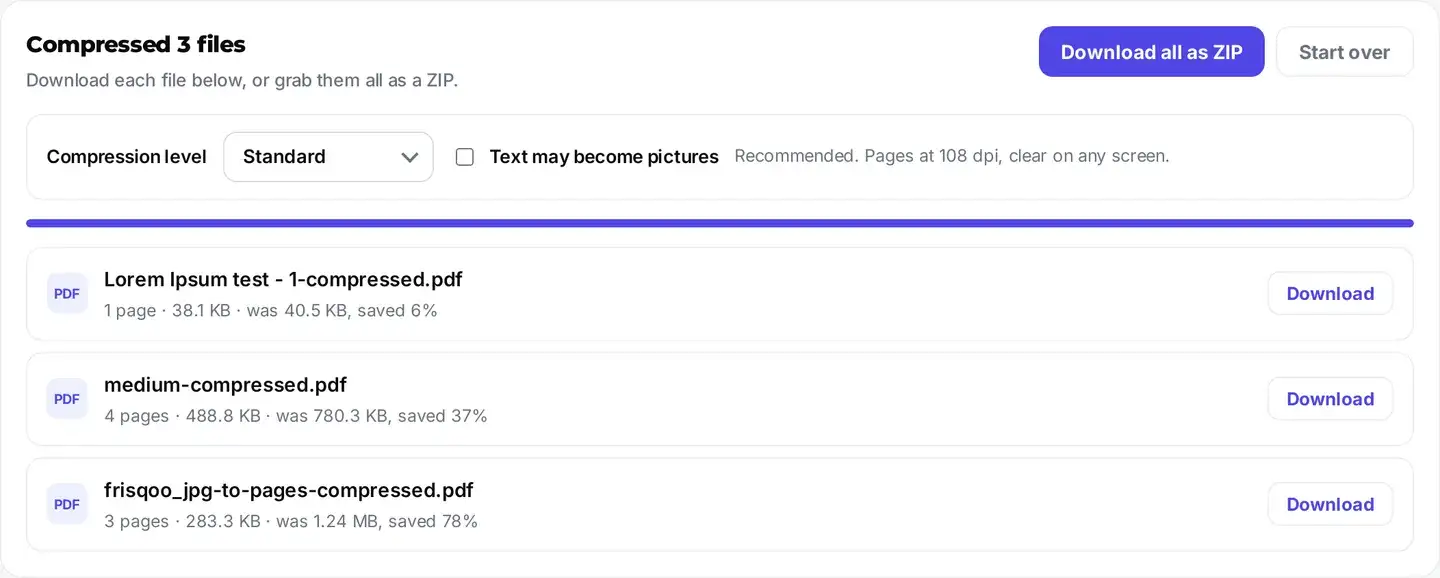
Each completed row reports its original size, result size and saving. Download files separately or use Download all as ZIP for a frisqoo_compressed.zip bundle. Change the level or picture setting to reveal Run all again at this level.
If a batch item cannot be made smaller, its original bytes and filename are passed through with an already-efficient note. Review those rows before assuming every source received a reduced copy.
Batch mode is convenient for related files, but one setting may not suit every document. Separate a text-heavy contract from a scan-heavy archive when they need different quality choices or when one file must keep selectable text.
Can Compress PDF reach 200 KB?
Compress PDF may reach 200 KB, but it cannot guarantee that target. A short monochrome scan has more room to shrink than a long report containing photos, fonts, annotations or forms.
To reduce PDF size, start with Standard, then test Smallest file and inspect legibility. If you still need to make PDF smaller or shrink PDF size further, remove unnecessary pages with Remove Pages or split a long document with Split PDF. Do not repeatedly recompress an already soft scan solely to chase a number.
A portal limit normally counts the downloaded file, so check its size in your device’s file manager rather than relying only on the source name. If the document still exceeds the limit, splitting it is safer than making critical text unreadable.
Why a PDF may barely shrink
A well-produced PDF may already use compressed streams, subset fonts and efficient images. In that case, structural cleanup has little left to remove. A vector-heavy document can also remain similar in size because its content is not made of large page images.
A no-saving result prevents a nominally compressed copy from being larger than the source. If the PDF is mostly text, removing pages or large embedded assets at the source is usually better than flattening every page.
Repeated compression can also have diminishing returns. JPEG page images have already discarded detail, and encoding them again may soften text and diagrams without producing a useful reduction. Compare against the untouched source each time.
Compress PDF on phone and for large jobs
You can compress PDF on phone in a current browser, but available memory determines the practical job size. Large scans need space for rendered page images and may complete more reliably on a desktop with more memory.
On narrow screens, use Compression options to open the settings panel. Keep the browser tab active during processing, avoid starting several memory-heavy tasks at once, and save the result before switching tools.
Because work stays on the device, performance varies with the browser, free memory and power-saving settings. If a large job stalls, retry fewer files at a time or move the source to a device with more available memory.
Review the compressed PDF
Open the downloaded file before deleting or replacing the original. A quick review catches tradeoffs that a file-size number cannot show.
- Check the first, middle and last pages, plus any page with small type, photos or transparency.
- Test text selection and search when the document must remain accessible or easy to quote.
- Open links, form fields, bookmarks and attachments that matter to the workflow.
- Confirm page count, page order and orientation against the source.
- Verify signatures, metadata and password protection separately before distribution.
Keep the source PDF until the smaller copy has passed these checks. The original remains the safest fallback if a receiving system rejects the compressed version.
For regulated or accessibility-sensitive documents, repeat the review in the software used by the recipient. A successful browser preview and download confirm that the file opens, but they do not certify compliance with an external submission standard.
FAQs about Compress PDF
Do my PDFs get uploaded?
No. Compression runs locally in your browser, and Frisqoo does not upload the source PDF for processing. Keep the tab open until the work and download finish.
How do I compress PDF file size?
The tool first tries a structural rewrite that repacks the PDF while keeping its document structure. Scanned pages can also be re-encoded as images. The smallest valid candidate is used only when it beats the original.
Which compression level should I choose?
Standard is the practical starting point. Highest quality uses 144 dpi for rasterized pages, Standard uses 108 dpi, and Smallest file uses 72 dpi. Check the measured sizes and open the result before sharing it.
Will text stay selectable and searchable?
Yes on the structural path. A scan is already made of page images. For a text PDF, pages become images only if you select Make it much smaller, text becomes pictures; that option removes selectable and searchable text.
Can I compress PDF with form fields?
The structural path is designed to preserve AcroForm fields, including files that need XFA rendering. Turning pages into pictures flattens the visible page and does not retain interactive fields, so test the downloaded form before relying on it.
Can I compress a password-protected PDF?
Yes, if you know the open password. Enter it in the local unlock prompt, then continue. The compressed result is not automatically protected again, so use Protect PDF afterward if the new copy needs a password.
Can I compress several PDFs together?
Yes. Add multiple PDFs, choose one level and picture setting for the run, then download each result or use Download all as ZIP. A changed setting can be applied with Run all again at this level.
Why did my PDF barely shrink?
It may already be efficiently encoded, or its real text and vector content may leave little safe room to reduce. If no candidate is smaller, a single-file job reports that result; a batch keeps the original instead of making it larger.
Can I reduce a PDF to 200 KB?
It may be possible, but there is no fixed target-size guarantee. The result depends on the original pages, images, fonts, forms and existing compression. Remove unneeded pages or try Smallest file when an upload limit is strict.
Is there a file-size or page limit?
There is no account quota in the tool, but browser memory and device performance set the practical limit. Large scans need more memory than short text documents and may work better on a desktop.
Can I compress PDF on a phone?
Yes in a current mobile browser, subject to the phone’s available memory. On a narrow screen, open Compression options to reach the levels and picture setting.
Is Compress PDF free with no sign-up?
Yes. The tool has no sign-up requirement and adds no watermark. Processing remains in your browser, while the result is saved through your browser’s normal download controls.