

CGPA Calculator
Add a row for each finished semester with its SGPA and the credits it carried, and your cumulative grade point average appears as you type. Every semester is weighted by its credits, which is why the answer is usually not the plain average of your SGPAs, and the tool shows you both figures so the difference is never a surprise. Enter the credits still to come and a target, and it works out the average you need from here. Everything runs inside your browser, so nothing is uploaded.
100% private. Your results are worked out in your browser and never uploaded.
Why use the frisqoo CGPA calculator
100% private
Your results never leave the tab. There is no upload, no account and no record of what you typed.
Every semester shown
Each semester is listed with the weighted points it contributed, so you can see where the figure came from.
What you still need
Set a target and the credits left, and get the average required from here, or an honest note that it cannot be reached.
Weighting made visible
The straight average is shown next to the credit-weighted one, so you can see exactly what the credits did.
No internet needed
Once this page has loaded, it needs no connection. The maths runs on your own device.
Any device
Runs in any modern browser on a phone, tablet or laptop. Nothing to install.
How to work out your CGPA
- Add a row for each semester with its SGPA and the credits it carried.
- Pick the scale your university uses, 10-point or 4-point.
- Enter the credits still to come and your target to see what it takes.
Everything runs on your device, so it is fast and your results stay private, even with no internet once the page has loaded.
How is CGPA actually calculated?
Multiply each semester SGPA by the credits that semester carried. Add those results, then divide by the total credits.
An SGPA of 8.0 across 20 credits contributes 160 points. An SGPA of 9.0 across 24 credits contributes 216. Together that is 376 points over 44 credits. Divide 376 by 44 and the CGPA is 8.55.
The stronger semester there was also the bigger one. That pulled the cumulative figure above the midpoint of the two results. Had the 9.0 come in a light 16-credit semester instead, the same two SGPAs would have produced a lower CGPA. The grades alone never tell you the answer.
Is CGPA the average of your SGPAs?
Only when every semester carries identical credits. Otherwise the plain average is a different number, and it is the wrong one.
In the example above, averaging 8.0 and 9.0 gives 8.50, while the credit-weighted figure is 8.55. Five hundredths sounds trivial until you are sitting on a 7.49 against a recruiter cut-off of 7.5. Over six or eight semesters of uneven size the gap grows, and it does not reliably favour you: heavy weak semesters push the true figure below the average you were quietly hoping for.
This is the single most common error in homemade spreadsheets, so the tool prints both numbers side by side. When your semesters happen to be equal in credits it says so plainly, and the two figures match. When they are not, it shows you the straight average, the weighted result, and the fact that the second one is what your transcript reports.
Why a strong semester moves the number less later on
Every new semester competes with all the credits you have already banked, so an identical result is worth less to your cumulative figure the further into a degree you get. The arithmetic behind that is simple, but the size of the effect surprises most people the first time they see it.
Start from a CGPA of 8.51 across 42 credits, which is 357.6 grade points. Add a 20-credit semester at 9.5 and you hold 547.6 points across 62 credits, a CGPA of 8.83. Run exactly the same semester late in the degree, once 82 credits are already behind you, and 8.51 becomes 8.70 instead. The work is identical and the movement is roughly half.
Early semesters are cheap to repair and late ones are expensive. A weak first year is worth attacking straight away rather than hoping to outrun it later. And a target that felt comfortable in your second year has to be rechecked in your fourth, because the credits left decide whether it is still reachable.
What do you need from the semesters that are left?
Your finished credits are already fixed. The only unknown is the average across the credits still to come.
Carry on with the same example: a CGPA of 8.55 over 44 credits, with 20 credits left and a target of 8.75. Finishing at 8.75 across 64 total credits means 560 points in all. You already hold 376, so the remaining 20 credits have to deliver 184, which is an average of 9.20. That is demanding but possible.
The same arithmetic sets the boundaries of what is still open to you. Score a perfect 10 across those 20 credits and you finish at 9.00; score zero and you land at 5.88. Every outcome you have left lives between those two numbers, and the planner prints all three so you can judge a target before committing to it.
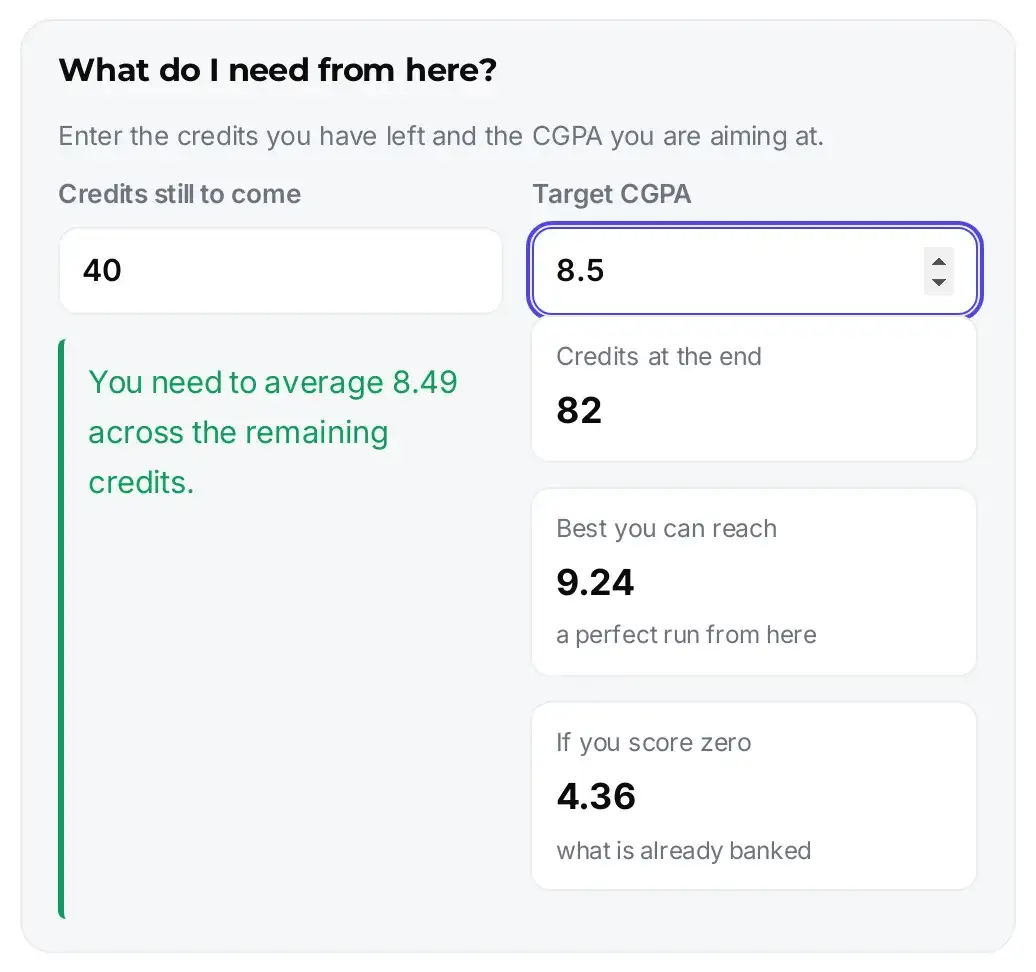
It will also tell you when the answer is no. If a target needs more than the scale allows, it says the target is out of reach and shows the best figure still available rather than displaying an impossible average as though you could go and earn it. If your target is already locked in whatever happens next, it says that too. A planner that only ever returns encouraging numbers is not much use in the week you are choosing electives.
Checking the figure against your transcript
The formula also works backwards, which makes it a check and not just a sum. Multiply your CGPA by your total credits. What you get back is the grade points behind it, the number this tool prints as weighted points.
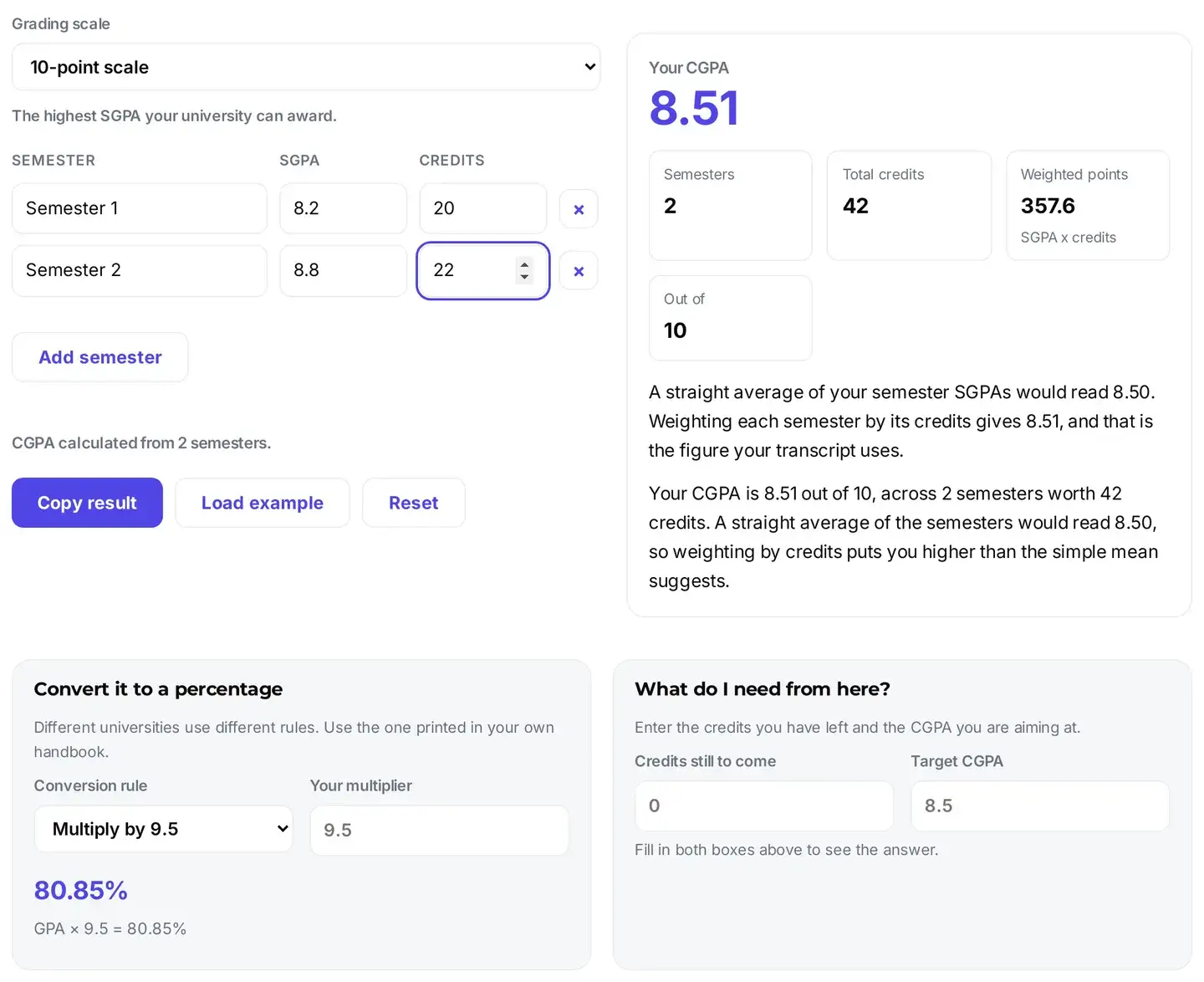
The two semesters in that figure carry 42 credits and 357.6 weighted points. Divide one by the other and you get the 8.51 shown above them. Your own marksheet prints a credits total and a grade points total near the foot. Divide those the same way. If the answer matches the CGPA your college published, your rows agree with the record.
If it does not match, the cause is usually one of three. Printed figures are rounded to two places, so a hundredth of a point is just rounding. A bigger gap often means a backlog was counted in a way you did not enter. A gap in the credits themselves points to an audit course or a paper that carries no credit.
Run this check once a year, not in your final week. An error you catch early is a short request to the exam office. The same error found in the month you apply somewhere is a much harder thing to fix.
Turning a CGPA into a percentage
There is no single national conversion. You apply the rule your own university prints, and three are in wide use.
One multiplies your CGPA by 9.5, a convention that began with a school board and spread well beyond it. Another multiplies by 10. A third subtracts 0.75 and then multiplies by 10, which some handbooks word as multiply by 10 and then subtract 7.5; those are two ways of writing the same sum. A CGPA of 8.0 therefore becomes 76, 80 or 72.5 percent purely according to which rule you were handed.
A seven and a half point spread is wide enough to change how an application is read, so this tool shows the formula next to whichever answer it gives and leaves the choice to you. Charts published online frequently disagree about the very same university. A chart from a search result is not evidence of anything. And for an employer, a scholarship body or an overseas admissions office, the number that counts is the one on an official conversion certificate from your examination office, not one from any calculator, this one included.
Backlogs, retakes and the figure on your transcript
Cumulative averages get complicated the moment a paper is failed, and universities resolve it in genuinely different ways rather than in variations on one standard.
Some replace the original grade once the paper is cleared, so the backlog leaves no trace. Some keep the first attempt in the cumulative figure permanently. Some record both attempts and count the better one. Some withhold the credits entirely until you pass, which changes the divisor rather than the numerator. These produce visibly different CGPAs from identical work, and no calculator can know which one applies to you.
The practical approach is to enter each semester exactly as your transcript reports it, and if a retake is involved, work it out both ways and take the question to your examination office. The difference between the two results is precisely what the answer is worth to you.
If you are still assembling the semester figures themselves, the SGPA calculator builds each one from your course credits and grades. Where results come as marks rather than grade points, use the marks percentage calculator, which copes with subjects of different maximums. And for the requirement that decides whether you sit the exam at all, there is the attendance calculator. The full set is on the calculators hub.
FAQs about CGPA Calculator
How is CGPA calculated?
Multiply each semester SGPA by the credits that semester carried, add those products, then divide by the total credits across all semesters. Two semesters, one at 8.0 over 20 credits and one at 9.0 over 24 credits, give 160 plus 216, which is 376, divided by 44 credits. That is a CGPA of 8.55. The credits are the weighting, and they are what makes this different from a plain average.
Is CGPA just the average of my SGPAs?
Only when every semester carries exactly the same credits, which is rarer than people assume. In the example above, the plain average of 8.0 and 9.0 is 8.50, but the credit-weighted answer is 8.55, because the stronger semester was the heavier one. The gap widens as your semesters differ in size, and it can run to a tenth of a point or more over a full degree. This tool shows both figures and tells you which one your transcript uses.
How do I convert CGPA to a percentage?
Use the rule your own university prints. Three are common: multiply by 9.5, multiply by 10, or subtract 0.75 and multiply by 10, which some handbooks write as multiply by 10 then subtract 7.5. Those two wordings are identical arithmetic. The same CGPA of 8.0 becomes 76, 80 or 72.5 percent depending only on the rule, so the tool shows the formula beside every answer instead of choosing silently.
What CGPA do I need in the remaining semesters?
Enter the credits still to come and the CGPA you are aiming at, and the planner works it out. It answers in one of three ways: the average you need across the remaining credits, a note that you have already secured the target no matter what happens next, or a note that the target is out of reach along with the best figure still possible. It never shows an average above the scale as though it were achievable.
What if my semesters carry different credits?
That is the normal case and it is exactly what the credit weighting is for. A 24-credit semester counts more than an 18-credit one, in proportion. If you averaged the SGPAs instead, a light semester would carry the same influence as a heavy one, which is the most frequent mistake when this is worked out by hand or in a spreadsheet.
Can I use a 4-point scale?
Yes. Switch the scale and every row is checked against the new maximum, so an entry that only made sense on a 10-point scale is flagged rather than quietly accepted. Converting a 10-point CGPA into a 4-point GPA is a separate question, and a rough divide by 2.5 is not what most admissions offices use. They usually recalculate from your transcript course by course, so ask the receiving institution rather than converting yourself.
Do backlogs and retakes change my CGPA?
Usually yes, and the rules vary more than any other part of this subject. Some universities replace the failed grade once you clear the paper, some keep the first attempt in the cumulative figure, some record both and count only the better one, and some withhold the credits until the paper is passed. Enter the semester as your transcript reports it, and if you are unsure, calculate it both ways and ask your examination office which one they publish.
What is a good CGPA?
As a rough guide, most Indian universities treat 6.0 as a pass, around 7.5 as first class and 8.5 and above as strong, while many recruiters screen at 7.0 or 7.5. These are conventions rather than rules, they differ by university and employer, and a CGPA is read alongside your projects and internships rather than on its own.
Is anything I type uploaded or saved?
No. Every calculation happens inside your browser using a small piece of JavaScript on this page. Your results are never sent to us or anyone else, there is no account, and nothing is stored once you close the tab. Once the page has loaded, it needs no connection to keep working.
Is it free?
Yes, free to use with no sign-up and no limit on how many semesters you add or how many times you use it.