

SGPA Calculator
Add a row for each course with its credits and the grade you were awarded, and your semester grade point average appears as you type. Credits do the weighting, so a four-credit paper counts for more than a one-credit lab, and every course is listed with the points it contributed. If you need a percentage, you pick the conversion rule your university prints and the arithmetic is shown alongside it. Everything runs inside your browser, so nothing is uploaded.
100% private. Your grades are worked out in your browser and never uploaded.
Why use the frisqoo SGPA calculator
100% private
Your grades never leave the tab. There is no upload, no account and no record of what you typed.
Every course shown
Each course is listed with the points it contributed, so you can see exactly where the average came from.
Grade points on show
The points behind every letter are printed next to it, so you can check them against your own regulations.
Your conversion rule
Three common percentage rules, or your own multiplier, each shown with the working that produced it.
No internet needed
Once this page has loaded, it needs no connection. The maths runs on your own device.
Any device
Runs in any modern browser on a phone, tablet or laptop. Nothing to install.
How to work out your SGPA
- Add a row for each course with its credits and the grade you were given.
- Pick the grading scale your university uses, 10-point or 4-point.
- Choose a percentage rule only if you actually need a percentage.
Everything runs on your device, so it is fast and your grades stay private, even with no internet once the page has loaded.
How is SGPA actually calculated?
Multiply each grade point by the credits that course carries. Add those results, then divide by the total credits.
Take three courses. A four-credit paper graded O is worth 10 points, so it contributes 40. A three-credit paper graded A is worth 8 points, contributing 24. A two-credit lab graded O contributes 20. That is 84 points across 9 credits, and 84 divided by 9 is an SGPA of 9.33.
Credits are the weights in that sum. That is why your SGPA is almost never the plain average of your grade points. Average the points on their own and you get a different figure as soon as the credits stop matching.
What each letter is worth
Grade points are the numbers behind the letters, and they are the part of the formula your university sets. On the ten-point scale, O is 10, A+ is 9, A is 8, B+ is 7, B is 6, C is 5 and P is 4. A failed course, F, is zero. Those numbers sit next to every letter in the grade list, so you can check them against your own regulations before you trust the answer.
The four-point scale is shorter. A is 4, B is 3, C is 2, D is 1 and F is zero. Switch between the two and any grade that exists on both is kept. A grade with no equivalent is cleared rather than rescored into something you never earned, so you pick it again yourself.
Letters are not standard across universities. Some award A1 and A2. Some use S for the top grade instead of O. The letters are only labels for the points, so if your handbook prints numbers this page does not offer, match the points and ignore the naming.
Why credits change the answer
Suppose you score a 10 in a one-credit lab and a 6 in a four-credit core paper. Averaging the grade points suggests 8.0, which looks respectable. Weighting by credits gives 6.8, because the paper you struggled with counted four times as heavily.
That gap is not a rounding detail. It is the difference between a first class and a borderline result on many transcripts, and it always favours the same direction: the courses with the most credits are the ones worth protecting.
It also has a practical consequence when you plan a semester. A high grade in a small elective moves your SGPA barely at all, while a mid grade in a heavy core paper moves it a lot. If you are choosing where to spend the last fortnight before exams, spend it where the credits are.
How do you turn an SGPA into a percentage?
You apply the rule your own university prints, and there is no single national one. Three are in wide use, and all three are built in here.
The first multiplies your SGPA by 9.5, a convention that began with a school board and spread far beyond it. The second multiplies by 10, which several engineering universities use. The third subtracts 0.75 and then multiplies by 10; if your handbook words it as multiply by 10 and then subtract 7.5, that is the same arithmetic written the other way round.
An SGPA of 8.0 becomes 76 percent, 80 percent or 72.5 percent, depending only on which rule you were handed. Seven and a half points is enough to move you across a recruiter cut-off. So this tool refuses to choose for you, and prints the formula next to every answer it gives.
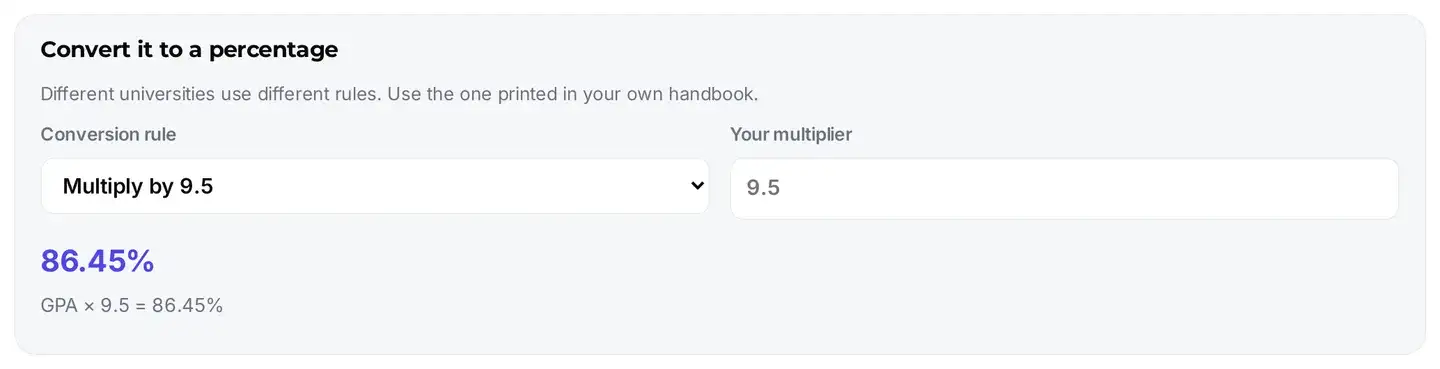
Published charts often disagree with each other about the very same university. A chart you found on a search result is not evidence. If a form is going to an employer, a scholarship body or an overseas admissions office, the figure that counts is the one on an official conversion certificate from your examination office, not the one from any calculator, including this one.
What grade do you need for a target SGPA?
Turn the formula around and it answers a more useful question, which is how much more you actually need. Multiply the SGPA you want by your total credits, and that product is the number of grade points the target demands. Take away the points you already hold, and what remains is your gap.
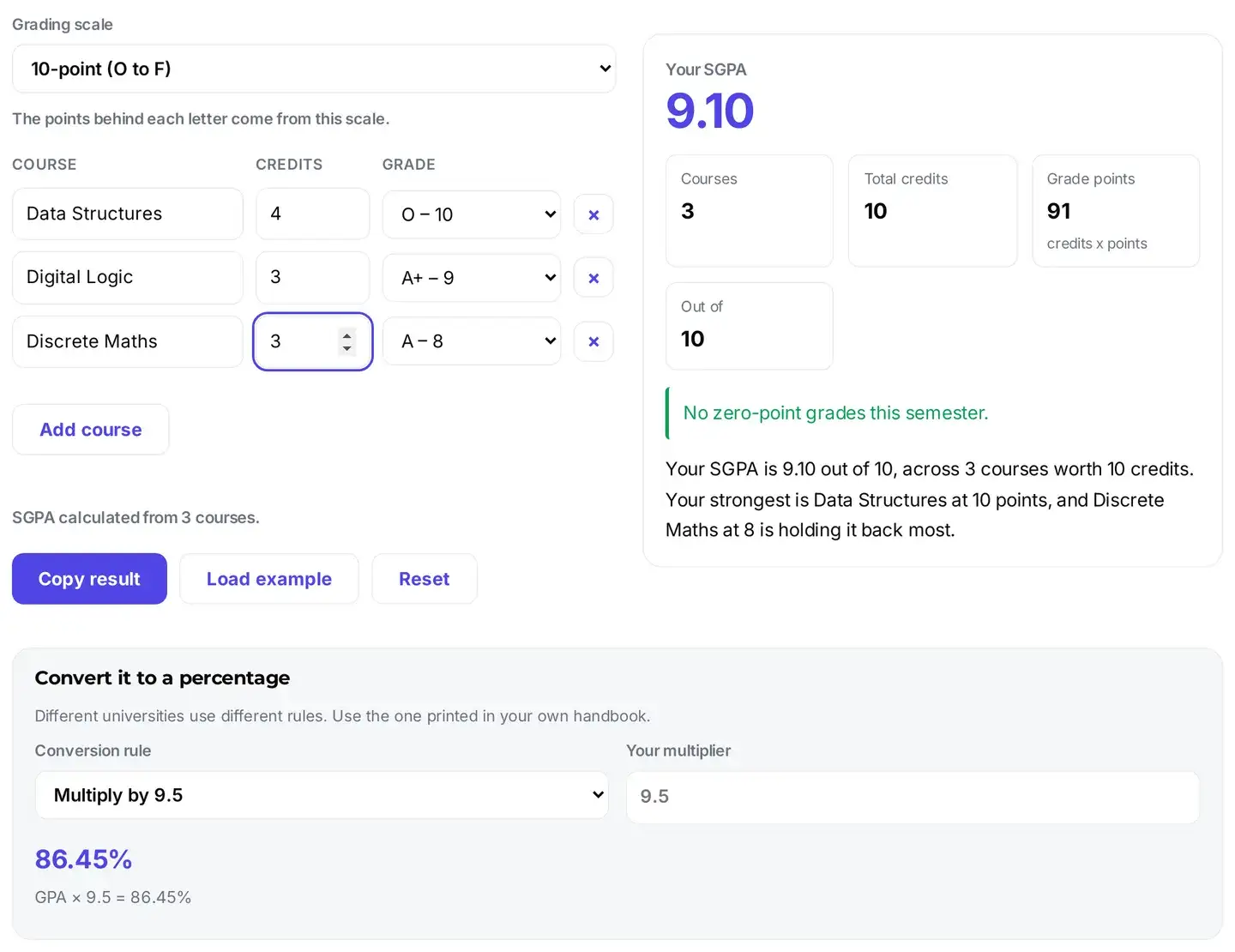
Take the semester in that figure, which is three courses carrying 10 credits and 91 grade points, an SGPA of 9.10. Suppose you want to finish the semester on 9.50 instead. Multiply 9.50 by those same 10 credits and the target becomes 95 points, so with 91 already in hand your gap is only 4 points.
Now look at where those 4 points can come from. The three-credit paper graded A is worth 8 points, and lifting it to O earns 10 instead, which adds 6 points rather than 2 because the credits multiply every gain. The total becomes 97 points over 10 credits, an SGPA of 9.70. The same two-grade jump on a one-credit course would add only 2 points and move the average by a third as much.
Where you push matters more than how hard you push. The credits decide whether a push counts for much at all.
What a failed course does to your average
A failed course normally scores zero grade points while its credits stay in the divisor. It hurts twice: it adds nothing to the top of the fraction and it makes the bottom bigger.
Two courses of four credits each, one graded O and one failed, give 40 points over 8 credits, an SGPA of 5.00, even though half your work was flawless. The tool flags any zero-point grade rather than hiding it, because that single row usually explains an average that looks inexplicably low.
Universities differ on what happens next. Some replace the zero once you clear the paper, some keep the original attempt in the cumulative figure, and some drop the credits until the course is passed. If yours excludes failed credits, delete that row and compare the two results; the difference is exactly what clearing the paper is worth to you.
SGPA, CGPA and which one people ask for
SGPA is one semester. CGPA is the whole degree so far. Almost every application form that says GPA means the cumulative one, so that is usually the number to quote.
They are built the same way, one level apart. SGPA weights courses by credits. CGPA weights whole semesters by the credits each semester carried. This is why adding up your semester results and dividing by the number of semesters gives the wrong answer whenever the semesters differ in size, which they usually do. To do that properly, use the CGPA calculator, which also works out the average you need from the remaining credits to finish on a target.
If your institution reports marks rather than grade points, the marks percentage calculator is the right tool instead, and it handles subjects with different maximums and per-subject pass marks. For the other number that decides whether you can sit the exam at all, there is the attendance calculator. The rest are collected on the calculators hub.
FAQs about SGPA Calculator
How is SGPA calculated?
Multiply each course grade point by the credits that course carries, add those products together, then divide by the total credits. Three courses worth 4, 3 and 2 credits, graded 9, 8 and 10 points, give 36 plus 24 plus 20, which is 80, divided by 9 credits. That is an SGPA of 8.89. Credits are the weighting, which is why a four-credit paper moves your average roughly twice as far as a two-credit one.
What is the difference between SGPA and CGPA?
SGPA covers one semester. CGPA covers your whole degree so far. The arithmetic is the same shape: SGPA weights each course by its credits, and CGPA weights each semester by the credits that semester carried. That is why your CGPA is not simply the average of your semester results whenever the semesters differ in size.
How do I convert SGPA to a percentage?
It depends entirely on your university, and that is not a dodge. Three rules are in common use: multiply by 9.5, which comes from a CBSE convention; multiply by 10, used by several engineering universities; and subtract 0.75 then multiply by 10, which you will also see written as multiply by 10 then subtract 7.5. Those last two are the same arithmetic. All three are offered here, and the one you pick is shown with its formula.
Why does this tool not pick a conversion formula for me?
Because picking one would make it wrong for most people. The same SGPA of 8.0 becomes 76 percent under the 9.5 rule, 80 percent under the 10 rule and 72.5 percent after the 0.75 deduction. That is a spread of seven and a half points, wide enough to move you across a placement cut-off. A tool that hides that choice looks more confident and is less useful, so the rule stays yours to choose.
What if my courses carry different credits?
That is the normal case and it is handled properly. Each course is weighted by its own credits, so a lab worth one credit and a core paper worth four count in proportion. If you averaged the grade points instead, the one-credit lab would carry the same influence as the four-credit paper, which is the most common mistake when this is done by hand.
How does a failed course affect my SGPA?
A failed course usually earns zero grade points while still counting its credits in the divisor, so it pulls the average down twice over. The tool shows that plainly rather than dropping the row: a zero-point grade is flagged, and the credits stay in the total. If your university excludes failed credits until they are cleared, remove that row and compare the two figures.
Can I use it for a 4-point scale?
Yes. Switch the scale and the grade list changes to A down to F, with A worth 4 points. If a grade you had already picked does not exist on the new scale, it is cleared rather than quietly rescored into something you did not choose. Grades that exist on both scales are kept.
What counts as a good SGPA?
Most Indian universities treat 6.0 as a pass, around 7.5 as first class and 8.5 and above as strong. Many recruiters screen at 7.0 or 7.5. These are conventions rather than rules, and they vary by university and by employer, so treat them as a rough guide and your own regulations as the authority.
Can it tell me what I need next semester?
That question belongs to your cumulative average rather than a single semester, so it lives on the CGPA calculator. Enter the semesters you have finished, the credits still to come and the CGPA you are aiming at, and it works out the average you need from here, or says plainly when a target can no longer be reached.
Is anything I type uploaded or saved?
No. Every calculation happens inside your browser using a small piece of JavaScript on this page. Your grades are never sent to us or anyone else, there is no account, and nothing is stored once you close the tab. Once the page has loaded, it needs no connection to keep working.